Sunday, April 10, 2022

Letting Life Break Us, Letting God Rebuild Us: The Seismic Shift of Easter


THE SYMBOL OF THE CROSS

Few things are so closely and exclusively associated with a single figure as is the cross with Jesus Christ. A cross on a necklace immediately identifies the wearer as a disciple. A crucifix in a church immediately conjures up in the mind an image of Jesus hanging in public agony. It’s a symbol that commands attention. It reminds us of Easter. It points us to God. For the Israelite Christians witnessing the crucifixion and death of Christ on Good Friday, however, the cross itself meant nothing but a criminal punishment.

And yet there was a very powerful symbol that stunned the early followers of Jesus Christ that day, something that had never happened before in history. It was completely unique to the death of Jesus Christ. Witnessed by only a few, it pointed dramatically to the eternal significance of the pivotal event of the Savior's death.

“Jesus, when he had cried again with a loud voice, saying, ‘Father, it is finished, thy will is done,’ yielded up the ghost. And behold, the veil of the temple was rent in twain from the top to the bottom. And the earth did quake, and the rocks rent…” (Matt. 27:50-51, Joseph Smith Translation).

To understand the mind-blowing nature of the rending of the veil, we need to know about ancient temples.

THE TEMPLE AT JERUSALEM

At the time of Christ, the temple at Jerusalem had recently been rebuilt and gloriously fitted and furnished on about 35 acres of a hill inside the city. Multiple walls and courtyards surrounded the temple and prevented anyone from entering without passing through a gate. Gates on the south, on the east, and the main gate on the west allowed anyone to enter the outer area, the Court of the Gentiles, but non-Jews could go no further, on penalty of death.

The Golden Gate still stands, now fitted with doors.

https://www.israelandstuff.com/palestinians-proclaim-victory-after-opening-temple-mounts-golden-gate

Passage into each of the inner courtyards or rooms required increasingly more qualifications as the faithful scaled stairways to pass through gates. Gentiles could not ascend to the Court of the Women. Women could not ascend to the Court of the Men. Ordinary Israelites could not climb to the Court of the Priests which contained the Brazen Sea, resting upon twelve bronze bulls and the altar of sacrifices. Although the people below could not enter this courtyard, they could see the smoke ascending to heaven in their behalf.

“Further steps led up to the actual temple, a comparatively small building. A priceless curtain, embroidered with a map of the known world, concealed from view what lay beyond, and none except the priest on duty was allowed to go farther. It contained the golden altar at which incense was offered and next to it the seven-branched candelabrum and the table with the twelve loaves of shewbread, which were replaced by fresh ones every sabbath.

“Beyond it, behind another large curtain, lay the Holy of Holies, which none except the high priest was allowed to enter, and he only on the Day of Atonement. A stone designated the place where once the Ark of the Covenant had stood [with its mercy seat between the two cherubim]” (https://www.bible-history.com/jewishtemple/).  (See also https://en.wikipedia.org/wiki/Second_Temple#Herod's_Temple).

All of these concentric gates, walls, and courtyards surrounded one central point in this stone temple: the Holy of Holies. Although we don’t know details about the activities in all of the temple courts (they were sacred, exclusive, and guarded even from historians), we do know what happened in the Holy of Holies on that single Day of Atonement each year because it is found in the Bible. (See Lev. 16; 23:26-32.)  The Holy of Holies had only one purpose: Atonement, the reuniting of God and man.

It was in this place that the high priest carried out rituals that symbolically cleansed all of Israel from sin and potentially allowed reconciliation with God.


Hindu Temple

The Israelites were not the only people to have a temple. Every great civilization in the history of the world had at its center a temple--the Egyptians, the Greeks, the Turks, the Mayans, the Aztecs, even Native North American civilizations all had temples. On every continent, in every advanced ancient culture, the temple was always the focal point of the greater community. (See, for example https://www.touropia.com/oldest-temples-in-the-world/.)

A temple was (and is), as Hugh Nibley calls it “a scale model of the universe…It is the meeting point of the heavens and the earth…The word for temple in Latin, templum, means the same thing as template…The temple is also an observatory…a place where you take your bearings on things. More than that, it is a working model, a laboratory for demonstrating basic principles by use of figures and symbols, which convey to finite minds things beyond their immediate experience” (Temple and Cosmos: Beyond This Ignorant Present, Deseret Book, 1992, 15, 19).

A survey of all of these ancient temples in all of these cultures reveals that they all had a common purpose: “to restore the primordial unity, that which existed before the Creation,…to restore the whole that preceded the Creation” (Mircea Eliade, quoted in Nibley, 380-1). Even though they did not know the God of Israel, they knew they were seeking wholeness, reunification, restoration. Although the rites of temples in various ancient civilizations morphed as well as decayed from the original temple experience God revealed to Adam (Moses 5:4-9), they shared this common purpose of reunification with their Creators or their Divine Parents in eternity.

But of all these temples, it was in the Hebrew temple at Jerusalem—where the Gentiles were unfit by birth, the women were unclean by nature, the men were unworthy, and even the priests were not holy enough to see into the presence of the Lord—it was here in Jerusalem that all of those barriers were torn away in a moment. God rent the veil of the temple—from the top to the bottom!--as Christ gave up the ghost and ascended into Heaven. Death, sorrow, separation, and sin were conquered. The passageway between heaven and earth was opened. Entrance into the “presence of God” on earth was now not only a possibility, but reunion with Them (God being plural) in eternity was a surety. Man could now sit down on the mercy seat with God or, as Lehi put it, “The Lord hath redeemed my soul from hell; I have beheld his glory, and I am encircled about eternally in the arms of his love” (2 Nephi 1:15).


SEISMIC SHIFTS IN HISTORY

Like the earthquake at the death of Jesus Christ, catastrophic events in history can bring about seismic shifts in doctrine and practice for God’s children.

·         For the Jews, the Babylonian captivity and the destruction of the temple forced them to produce the Torah. The Torah preserved their religion which had previously been completely tied to a particular place on earth: the temple at Jerusalem. They could now carry their religious beliefs with them wherever they went.

·         For the Christians, the death of Christ completely changed their understanding of and relationship with God, as shown in the New Testament. Jesus returned and taught his disciples privately, and they changed their old image of God as a fearful punisher, to God as a loving and merciful Parent. This new understanding allowed them to bring heaven to earth in their Zion-like community.

·         For the Nephite colony, the destruction of Jerusalem made them realize they were no longer an outpost, but the home base of Israelite worship on the earth. This led to the recording of doctrine and history that became the Book of Mormon. The only Jewish temples on earth were the ones built in the New World. The Book of Mormon shows us that the Gospel of Jesus Christ existed along with the Law of Moses from the beginning. The Old Testament does not make this obvious. (See Terryl Givens, 2nd Nephi: A Brief Theological Introduction, Brigham Young University.)

PERSONAL SEISMIC SHIFTS

When cataclysmic events happen in our own lives, our ability to make sense of the universe is shaken. The mountains are in new places, the former home base is gone, some things are broken beyond repair. We don’t recognize the landscape anymore. We have to get our bearings again from a new perspective. But sometimes that is precisely what is needed to allow us to throw off old incomplete beliefs and gain new, more accurate ones.

As the sweet children’s book I just bought my grandson explains it:

“Out of death, comes life. That’s how God wants us to see Easter.”

“I still don’t like dying.”

“Neither do I. We were born to love life. God loves life. But sometimes we have to let go of one thing so we can move on to another” (Lisa Tawn Bergren, God Gave Us Easter, Waterbrook Press).

When we lose a loved one (I attended the funeral of one today), when health crises happen, when people betray us, when hatred and war threaten and destroy, we can remember that good will come of catastrophe, if we let God lead us.

We can remember that the cross became the symbol of faith, hope, and love.

We can remember that the destruction of the holy temple veil symbolized every man and woman’s personal access to God and His mercy. Our temples today are clear in teaching this truth—that we may reach out personally and individually for the hand of Christ and be drawn into his presence thanks to His infinite sacrifice on Easter.

The death of Jesus Christ is the greatest irony that ever was—the seismic shift that provided reunification and wholeness for all, the earthquake that broke everything in order to put it right.


Friday, January 28, 2022

Wide as Eternity: The Visions of Enoch

The Backdrop of the Vision of Enoch

The opening verse of Moses 7 encapsulates the greatest and most persistent problem of the family of God: that “many have believed [the gospel as taught by Adam] and become the [children] of God, and many have believed not, and have perished in their sins, and are looking forth with fear, in torment, for the fiery indignation of the wrath of God to be poured out upon them.”

Because of this revelation, Enoch began to prophesy from that time forth. (See verse 2.) As he preaches, he tells his audience about the visions he has been shown for their benefit. Those who listened and learned became the City of Enoch and were taken up into heaven. Although the story of the City remained in the Old Testament, the truths learned by them were lost from the earth until Jesus restored them in the meridian of time, and Joseph Smith restored them in the translation of Moses 7.

The vision of Enoch is a revolutionary scripture, overturning concepts that have been the basis of most nations, religions, cultures, and even individuals--that there is an “us” and a “them,” that we are right, and they are wrong, and that we will achieve happiness when we are avenged and triumph over our enemies. The vision teaches the concept that we are all brothers and sisters and only completely uniting the family of God will lead to a fulness of joy.

This concept was revolutionary in Enoch’s day--so revolutionary, it didn’t even make it into the Old Testament. It was again revolutionary in Jesus’s day and formed the basis of the original Christian church. It is revolutionary again in our day as we recover from centuries of misunderstanding about God, about sin, about judgment and salvation, and about the relationship between all the peoples of the earth. In restoring this truth, Joseph Smith upended the teachings promulgated by the greatest “Christian” thinkers and leaders since the apostles were killed. (For the history and details of this loss, I highly recommend the books by Terryl and Fiona Givens, The God Who Weeps, All Things New, and The Christ Who Heals. Really, every Latter-day Saint should read at least one of these books.)

Revolutionary Concepts #1 and #2: The mighty God of heaven is a PERSON, and He took the time to talk with one of His lowly creations.

“I saw the Lord; and he stood before my face, and he talked with me, even as a man talketh one with another, face, face” (verse 4).

Revolutionary Concept #3: Despite great wickedness and wars on the earth, a group of people could become as holy as heaven.

“The Lord came and dwelt with his people, and they dwelt in righteousness” (verse 16). “The glory [great joy] of the Lord…was upon his people.   “The Lord called his people Zion, because they were on one heart and one mind, and dwelt in righteousness; and there was no poor among them” (verse 18). “[Enoch, in passage of time] built a city that was called the City of Holiness, even Zion. (verse 19).  “Zion, in process of time, was taken up into heaven” (verse 21).

Revolutionary Concept #4: God experiences emotions, including sorrow; He cares about his children. Although they were “looking forth with fear, in torment, for the fiery indignation of the wrath of God to be poured out upon them” (verse 1), God Himself was weeping at their estrangement. While Enoch was rejoicing that Zion was safe from evil, God was mourning the separation from “the residue of the people” who remained in wickedness (verse 28). (Although God cursed them [verse 20], it is an indirect cursing—simply the natural consequence of breaking His laws.) Enoch is utterly shocked that God, who is all powerful, all knowing, eternal, kind, perfect in every way, and has just seen the success of Zion, is now weeping (verse 31).

Revolutionary Concept #6: Our enemies are not our enemies, but our siblings. There are groups of people mentioned in the chapter who are hateful of each other: the people of Canaan are at war with people of Shum (verse 7). The war brings about a barrenness in the land, presumably from destruction of crops and other plants, and changes the climate of the area (verses 7-8) from which it never recovers. Possibly as a consequence of this--since it is announced in the same sentence--the people of Canaan experience a blackening of appearance that further separates them and causes all other people to despise them (verse 8). Multiple other groups of people in lands that are unknown to us today are mentioned, and the Lord commands Enoch to preach repentance to them (verse 9-10). Enoch preaches the gospel of Christ, encapsulated today in our Fourth Article of Faith, to all of these groups except the people of Canaan (verse 12). No explanation is given as to why He didn’t preach to them.

Because of the terrifying miracles Enoch can perform to protect his people, their enemies “fled and stood afar off and went upon the land which came up out of the depth of the sea. And the giants of the land, also, stood afar off…” (verses 13-15). There are wars everywhere, violence, hatred, bloodshed—separation (verse 16). The seed of Cain still were excluded from other societies because of the color of their skin (verse 22).

Only the people of Zion are spared from war, but whereas Enoch has previously been glorying that his city is rescued from their enemies, the Lord points out that the enemies are Enoch’s brethren.  “The Lord said unto Enoch: Behold these thy brethren… (verse 32).” From this point on, the word enemies disappears, replaced by brethren and children: family members!

Revolutionary Concept #5: Becoming holy does not create complete joy;  instead, holiness brings acute awareness of the suffering of our siblings (our enemies) because of their sins. I gave unto man his agency; and unto thy brethren have I said, and also given commandment, that they should love one another, and that they should choose me [as] their Father; but behold, they are without affection, and they hate their own blood (verses 32-33).” “Satan shall be their father, and misery shall be their doom; and the whole heavens shall weep over them, even all the workmanship of mine hands; wherefore should not the heavens weep, seeing these shall suffer? (verse 37)? It is separation from God and from each other that causes suffering among human beings.

The heavens weep, not for the sin of the people, but for the suffering that sin causes before their redemption (verse 37): “Until that day they shall be in torment; wherefore, for this shall the heavens weep, yea and all the workmanship of mine hands (verses 39-40).

Noah would build an ark to protect his family from the flood, and God would “smile” upon it, but “the residue of the wicked” would perish.

When Enoch saw this, he “wept and stretched forth his arms, and his heart swelled wide as eternity; and his bowels yearned; and all eternity shook” (verse 41). He “wept over his brethren, and said unto the heavens: I will refuse to be comforted; but the Lord said unto Enoch: Lift up your heart, and be glad; and look” (verse 44).

Revolutionary Concept #6: Christ’s atonement will cover even those who did not learn righteousness and unity while on the earth.  Enoch looked and no longer saw the wicked as his enemies, but as the families of the earth, and he asked when Christ would atone for them, and “they that mourn” will be sanctified and have eternal life (verse 45). And then he saw “the day of the coming of the Son of Man, even in the flesh; and his soul rejoiced…” (verse 47).

After the agony of the cross and the agony of the earth in response to the crucifixion, not only do “saints” arise and to be crowned at the right hand of God (verse 56), but also “the spirits as were in prison came forth, and stood on the right hand of God (verse 57). But a remainder (the word remainder suggests a small number) still waits “in chains of darkness until the judgment of the great day.”

Revolutionary Concept #7: A fulness of joy is only achieved with complete unity. The earth will finally rest when Christ comes again and enmity is removed from the family of God. Then “righteousness and truth will sweep the earth as with a flood” just as the waters swept the wicked off the earth previously (verse 52). The City of Enoch will come down to join Zion on earth, the New Jerusalem, “and we will receive them into our bosom, and they shall see us; and we will fall upon their necks, and they shall fall upon our necks, and we will kiss each other” (verse 63). There will be a thousand years of peace upon the earth. Finally at the end of the world a fulness of joy is finally achieved (verse 67).

What does this mean in your life?

We are confronted many times daily, even hourly, with the temptation to separate. We view others’ successes with jealousy.

We polarize ourselves into political groups.

We struggle to view other races and cultures as less than ours, even when we are trying to be kind.

We have no idea how to feel about people with nonbinary sexual orientations.

We may think our country is the greatest.

We may resent immigrants or refugees or people who don’t learn to speak our language.

We may be suspicious of those who are different.

We may have struggles to forgive those who have wronged us.

We may say that everyone is a child of God, but we feel that perhaps our group contains the best children of God, as if the rest are a different class of family members.

In all of these daily situations, we are only free to be truly happy when we unite ourselves with our Heavenly Father and view all “others” as our suffering siblings. Once we have this view, the Holy Ghost can guide us in how to love and accept others and how to share the gospel with them so that we can be one.


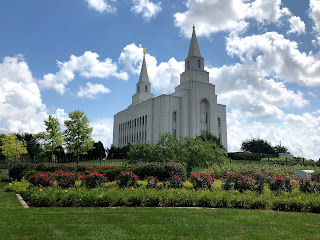
Kansas City Temple
I hold the copyright. Feel free to use it.

Friday, December 24, 2021

2022 Supplements

2022


Lesson supplements for all of the standard works can be found at the top of the home page. 

Please click on those links to find the appropriate lesson.

Best Wishes for a Joyous New Year!
Whether we get to have "precendented times" again
or whether it's another year of These Unprecedented Times,
the gospel of Jesus Christ (love) is the answer to all problems (fear).

Sunday, December 12, 2021

Thursday, December 9, 2021

Bonus Lessons, vaguely related to The Family Proclamation

I hold the copyright to this photo of the Logan Temple 
taken earlier this month, but you are most welcome 
to copy and use it.

I don't have time or ability to put together a lesson on The Family Proclamation right now, but here are some great lessons that are vaguely related to it.

The Family Proclamation gives us the ideals for family life. But...what if your family is dysfunctional? Is there hope for you? Well, there was for Vaughan J. Featherstone and Abraham the Prophet.

And I just really love sharing this story from Church history of a family man who turned his life over to God, helped many families, and promoted family values among all his employees: Jesse Knight

Sunday, October 31, 2021

Doctrine and Covenants 124-128

Rather than posting a new lesson for these sections, I'm sharing links to old related posts. I so enjoyed researching and writing about these topics! I hope you will find them useful.

 Nauvoo


I have a tradition of doing a puzzle 
while I watch General Conference at home.  
This fun puzzle is called "Celebrating the Restoration." 


Sunday, October 3, 2021

General Conference

 Fun facts about General Conference:

"A Brief History of General Conference"

Photograph from JacobsenConstruction.com